
A Total Eclipse, with No Heart
A review of the Housemarque's new game, "Saros". A game with great ideas, and fantastic gameplay, that is undercut routinely by annoying narrative hurdles and middling to poor character performances.

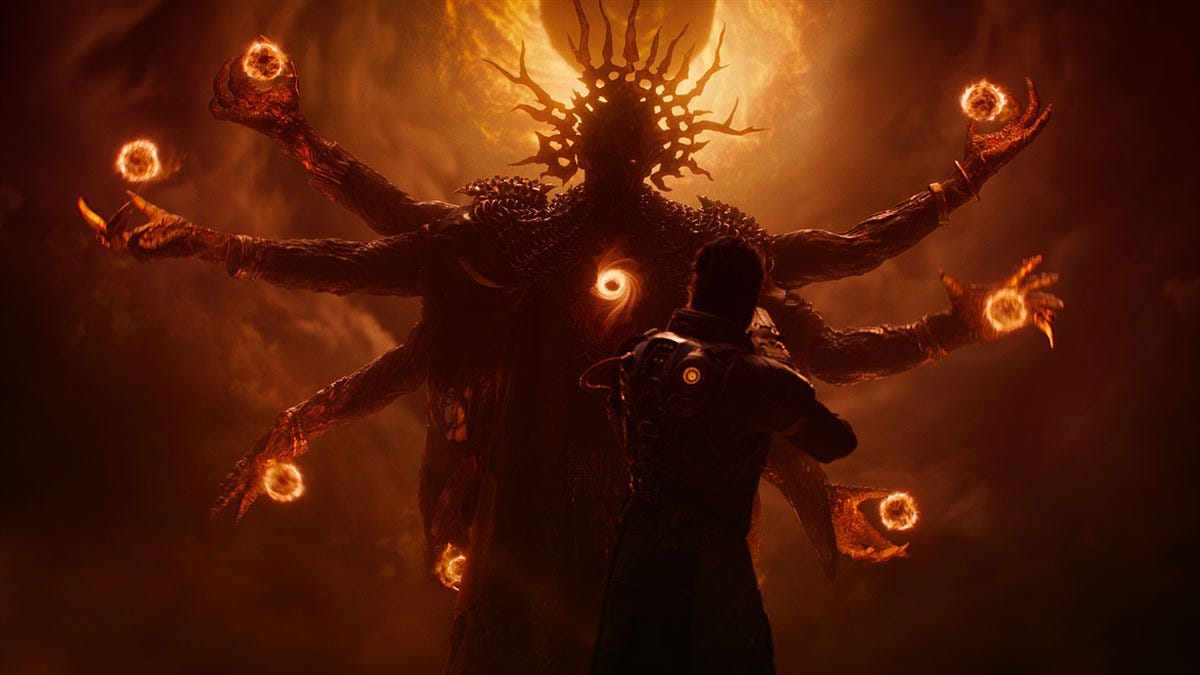
Not going to lie, pretty tired of hearing about this “Yellow King” guy everyone keeps yammering on about. Take a vacation to a real beach, instead of painting about one, yeah? Quit talking in riddles!!!
Saros is one of the crispest and most playable video games I’ve played in a fair bit. It’s so instantly engaging and kinetic, you just can’t help but fall in love with its extensive language of gameplay verbs. It’s a real thrill to play, from the moment you take control of Arjun Devraj, the main character of Saros.
You are a whirlwind of death, here. Very few games both give you the tools to empower you and then go out and challenge you to use all your tools to conquer their combat puzzles, as Housemarque does with this game. If you aren’t moving in a battle, you’re dead, and Housemarque, the developers of Saros and its spiritual ancestor, Returnal, has supplied the player with more than enough powerful tools and dextrous movement to pull off the large hurdles they set before you throughout Saros’ 15-20 hour campaign. That time is dependent on how skilled you are as a player, of course. But unfortunately, I am pretty mixed on Saros. I really like a lot of core things about the way it handles, how it rewards skillful play, the visuals, and the sound design, but I was consistently bummed out by the narrative, dialogue, and characters throughout my time with it.
Presentationally, it’s exceptional. There were many times, as I moved throughout the sepia-toned biomes of Carcosa, that I gazed in awe at the sheer brilliance of visual design on display. The unifying thematic and visual motif of Saros has to do with the Sun and solar eclipses, and that bonding agent ties the entire game cohesively in its visuals. It’s a stupendous feat of character design, enemy design, and environmental art all coming together to pull off one of the greatest-looking games on the market. Every part of the way the game looks presentationally comes together beautifully to paint the picture of a fallen world in need of saving. There isn’t much out there in games that looks or sounds quite like Saros, and that makes the whole affair feel fresh and new as a result. It’s gorgeous to look at.
Avoiding spoilers, the final boss encounter of this game, along with the accompanying cutscene showing off the big bad in all his yellow glory, is cinematically arresting. I can’t remember being as gobsmacked looking at a video game artistically since maybe Metaphor: Re Fantazio from a couple of years back. Remember the old Gamespot review system from back in the day, where they would grade games on the metrics of both ‘graphics technical’ and ‘graphics artistic’?? If those metrics were used today, Saros would take home the gold for both. It’s artistically and technologically one of the most impressive video games out there.
It wouldn’t mean much, though, if it were only pretty to look at. The real victory of the encounter design is that all the fights are actually legible. All the fiery assaults of color-coded pellets being flung your way by enemies are completely readable, and parsing the ever-evolving combat puzzle is the true highlight of Saros. You dash, strike, and shield yourself against the ever-advancing hordes of Carcosa’s alien foes, and doing so is such a joy. The pure act of simply playing Saros is fantastic.
To talk about the structure of this game, you kinda have to talk about Returnal to compare, I think. Returnal is Housemarque’s spiritual ancestor to Saros, in almost every way. It’s similar in so many ways that you’d be forgiven for wondering why it isn’t just Returnal 2. It is Returnal. But it’s easier Returnal. The main focus of Saros is to navigate the ever-changing biomes of Carcosa, beating stage bosses along the way to mark your progress. You have an upgrade tree that caps out at locked intervals, gated by your progress of beating said bosses. You can’t ever truly overlevel in Saros, at least not with the permanent upgrades. But the whole game is simply easier than Returnal, given the things that stay with you run to run.
Returnal is different in that way, where there are some permanent upgrades to be had, but you are really picking up items to take with you on a long run back to a boss, and that is the main issue with that game: the runs are way too long. Returnal is more of a roguelike than Saros is, but in some way, the hyper-focused intensity of the true random chance that Returnal deals in is just more honest of a structure than Saros is. Housemarque wanted to correct the gripes that people had with Returnal, which were: getting killed on a long run being a huge buzz-kill, and the game was really hard. Striking that forward momentum down so frequently actively pushed gamers away from Returnal. Housemarque corrects these issues here in Saros, but they do so at the cost of drilling down on the roguelike nature of the affair. It’s a flawed genre, and the ones that do it right do it well, but Saros seems more concerned about appeasing the many that bounced off Returnal, rather than enhancing the roguelike nature of their first effort.
The structure is stage-based in Saros, while in Returnal, it’s more checkpoint-based. You had to scramble through a part of each biome in Returnal without dying to get back to the last spot you died in. One of the enemies in that stage would, like a Souls-like enemy, have your previous run’s currency stored inside of them, so that when you killed them in an act of vengeance, you would re-gather your lost currency. In Saros, you simply have a teleporter that is used to warp back to specific biomes rather than have the tall task of trying to stay alive, getting right back to where you were, and you have some amount of permanent currency called Lucenite, (the somewhat ‘MacGuffin’ of Saros) and Halcyon (high-value drops of currency to be used in the skill tree) that you bring back between runs.
Given the more friendly nature of the leveling system and the permanent currency, it’s sometimes more advantageous to simply farm for materials in previous biomes, to increase Arjun’s skills, rather than hoof it to a boss and die. The bosses in Saros aren’t as difficult as the ones in Returnal, where if you die on one, you go all the way back to the beginning of a run; Saros is a game far more concerned with you finishing it. More than anything, that is the truth. It’s a game that was made to assist the player, more than ever, in finishing it. Nowhere is this more evident than in the modifiers that Housemarque gives you to alter your stage-based runs. It’s a sort of balance sheet here, that for every boon you give yourself, you must take a detrimental debuff to counteract that advantage. That system is a good idea, but in practice, it makes an already mild game far easier. Mild in comparison to Returnal, that is anyway. It’s still very challenging at times, dependent on the obstacle. But I had a pretty easy time finishing it.
Saros is a game sort of ashamed to be a roguelike, and that feeling shows throughout the adventure. Every concession they have made in the gameplay structure betrays a sense of inherent frustration on behalf of the developers. I think Returnal was the game they wanted to make, while Saros is the game they had to make to allow more people to engage with Returnal’s ideas. It’s a jack of all trades situation here. Not being able to drill down on any core system, because you are allowing for a more inviting experience, does ultimately file down the teeth of a great idea.
I think the only thing I would have changed between the two games would be fast travelling. I would have the teleport be available, and that’s it. I simply wanted to get back in the fight more quickly instead of retreading my steps to build myself up. I am more interested in the encounters, not the ‘stuff’ as it were, but Returnal made the constant resetting of the game feel like a chore after a while. This must be a frustrating thing for a developer, I imagine. They fixed all the issues people had with Saros, added ease of travel and offered difficulty modifiers, and people like me still complain that it was better in some way before. That kinda sucks, I’ll admit.
I do think it may be proof positive that sometimes the gamer just isn’t always right. I thought having these changes would be beneficial, but in actuality, the game becomes sort of a cakewalk given those alterations. It echoes in a similar way to me the issues people had with DOOM Eternal, and as a response to that criticism, id Software gave us DOOM: The Dark Ages. A better video game with less friction, but less impact as a result. There isn’t any winning when devs kowtow to players who are inherently a finicky bunch like myself. I know I am the problem here!
The visuals and the gameplay are great. It also sounds awesome. Lots of good, bassy notes in the gameplay. The music is sorta forgettable, with it all blending for me into a sort of loud, cacophony of synths and robotic bass. It’s not bad, just nothing to write home about.
Some of the systems and structures have made finishing it far easier, which comes at the cost of sanding off the more interesting friction of the game as a result. While it isn’t a brutal task to finish Saros, it is a far easier game to see through, clocking it at roughly half the time of what it takes to finish the previous game, Returnal. This isn’t a bad thing, because as a man with limited time, I appreciate my time not being wasted for the sake of padding its runtime. But the whole affair is a bit of a blur, as a result.
So far, there are a lot of positives. The reasons I am so mixed on Saros have everything to do with the story, the characters, and the dialogue. When you are playing Saros, you kinda don’t care what’s going on, and I prefer it that way. I would be invested in the yarn Housemarque is spinning if the writing were maybe better? The biggest issues I have with this game, besides some of the sanded-off gameplay structure, are the writing and the price of admission to play the game.
First off: the writing in Saros is not just mediocre, I’d go as far as to say it is outright bad. It is a bad story, filled with unlikable characters, going through a confusing plot, lined with some of the worst dialogue I’ve had to sit through in a triple-A game recently. Everyone in this game at some interval is losing their mind, and that fact becomes extremely apparent when any character affected starts doing the same damn thing: they all start talking in riddles, yakking about some eldritch aspiration they are influenced by. It’s terrible, and as the game continues on, it becomes more prevalent, and the game is worse because of it. I’d like to ignore it, but I want to give actual criticism of the parts of the game, so I had to endure it for the full duration. Arjun is not the problem here, but he isn’t great either. He seems to be surrounded by members of a cult, all with their own manic, inside jokes, and that gives the narrative a feeling of obliqueness in an annoying way, not in a mysterious way like the game wants it to feel. It’s just awful. If I have to hear about the ‘Sun that was promised!’ one more fucking time, I may just commit an actual crime. In some ways, the cast’s loss of their sanity contributed to me also feeling crazed as well by the end.
It’s not just the dialogue; the characters are bad. There are a lot of characters in this game, too. The whole retinue of the Echelon program has either died or lost their marbles, and even as things become clearer in the story between Arjun and his long-lost love, it becomes more evident how much of a piece of shit he is. Not even Rahul Kohli can save the proceedings either, with his gruff, aloof shooter-man dialogue failing to reach deaf ears at the best of times in the narrative. It’s a shame, too, because I like the actor! He just doesn’t get a lot of help delivering a poor script. They never give him as an actor the avenue to show off his natural charisma, and that’s a big bummer. They make Arjun feel like a pissed-off ape of a soldier in search of a lost possession rather than seeking out a loved one, and the delivery of bad dialogue on behalf of Arjun is just sort of a shame, to me. He had all the potential to be a cool character, especially given how good the main protagonist of Returnal, Selene, was. The story was actually great there, too. They do the same tricks here in Saros, just worse. It’s a big bummer. Not delivering on the narrative is one of the biggest disappointments I have with the game. I get that it kinda isn’t the point of the thing, but if you’re going to include the story, make sure to make it at least palatable?
The only character I kind of liked in Saros was the AI robot Primary, who at least commits to the slow insanity bit in an interesting way, given his position as an artificial being. He dryly muses regularly about the same things the other characters in Saros do; he just delivers it better, and there is a degree of pathos to his performance I appreciate. Besides his actual gameplay function of being the main hub’s navigation menu and level-up screen, Primary is pretty much the secondary character in Saros, and he is by far the best of a bad bunch. The game stumbles so often narratively that it’s hard to see past it sometimes, and I want to play the game. If the given impetus sucks, why would I want to engage with the specifics? I was usually able to delineate the quality between the narrative and the gameplay while I played, but at many times it was really rough.
The game feels so good to play, but it is constantly punctuated by terrible dialogue, characters, and story; it’s hard to ignore it. It has all the makings of a prestige, Sony-published triple-A video game, but with none of the execution or care given to the story as the gameplay. It’s a frustrating Jekyll and Hyde of a game. It wants to be seen like a game of its peers, like a Naughty Dog game, a Guerrilla project, or a Santa Monica title, in terms of renown— but it just doesn’t have the narrative dexterity that those games do, and it’s lesser for it. In some ways, it’s kind of an imposter to the prestige Sony game, given its price tag.
It’s a $70 video game, and for that price, it better be damn worth the ask, but I just don’t think it is. $50 seems to be a top-out scale for an ‘agreed upon’ price for any one of these games in the roguelike genre. Exceeding that already steep price tag seems to be a big ask for anyone who even likes roguelikes. Everyone seems to be in the same boat here: 70 bucks for a roguelike is too much. Sony is bucking that idea by kicking up the price of admission 20 bucks past that $50 top-out for most people, because they feel they have a prestige title, and I think that is going to adversely affect its sales.
Everyone playing this game understands its value except for the publisher, here, and that’s going to be a problem for Housemarque if they look to do this sort of thing again. From the looks of it, I don’t think they’ll get another bite of the apple because of this steep ask, which isn’t their fault, unfortunately. It’s a good game, and great at times, but I believe it’s just not worth the high ask if I am honest.
All told, I feel a certain way about Saros. As the title of this post says, it’s a “Total Eclipse, with No Heart”. The game is gorgeous to look at and listen to, and sets the standard for shooter gameplay in roguelikes, but the impetus to do so is an active annoyance to me while playing it, given its numerous narrative mishaps. It’s a game with no soul. Saros is a good game that could have been great if more care had been given to the other particulars outside of the gameplay and presentation. High marks to the artists and designers of the game, though. Housemarque’s visual splendor, technical brilliance, and mechanical prowess as a developer have never been better than they are here.
I recommend this game, but not at $70. Please wait for a sale, and if you can stomach the game’s narrative issues, what you will find is a big-budget arcade shooter that looks and plays so good, you’ll have to see it to believe it. I wanted to like more than I did, but I have to be honest about these things.
As always, “It’s been a thin slice of Heaven.” Shout out, Dave Dameshek.