"Blue Prince", is Almost Perfect
A review of Blue Prince, games that you play in your head, and the frustration of random happenstance.
“A doughnut hole in the doughnut's hole. But we must look a little closer. And when we do, we see that the doughnut hole has a hole in its center - it is not a doughnut hole at all but a smaller doughnut with its own hole, and our doughnut is not whole at all!”
-Benoit Blanc: “Knives Out”-
Blue Prince is so close to perfection.
When I mean close, I mean like a hairs breadth away, sort of close to perfection that not many games reach today.
By the time I was finished with Blue Prince, I was satisfied and not looking for more, and that’s more to do with the nature of the game’s design than the mysteries that lie hidden in the nooks and crannies of every room you draft as you make your way to the infamous Room 46 of Mt. Holly’s ever changing floorplan.
It’s one of those games that you ‘play in your head’. I love this genre of game. Outer Wilds, Return of the Obra Dinn, Chants of Senaar, The Case of the Golden Idol, and also, The Witness fit this sort of description. Games where knowledge is ‘power’, truly.
You do this sort of cerebral calculation of information to further your understanding of the game’s world. But just ‘knowing things’ isn’t enough, however. You have to apply that knowledge.
Information in the game is currency, and using it well is vital. Knowledge can become a permanent addition to your arsenal of tools if you arm yourself well.
The more you know and can do with the information you have gathered, exploring the game’s world, the more you can affect the state of it and the underlying mechanics beneath.
This sort of ‘sub-genre’ of game has become one of my favorites.
As my physical skills start to wane with age, my mind tends to be sharper as I grow older. Unraveling puzzle games’ proverbial ‘ball of yarn’ has never been more satisfying than it is to me now.
I like this type of puzzle game. It’s become one of my favorite types of genres when it comes to playing video games.
I guess my tastes have matured a bit. Maybe I’ll take up crossword puzzles one day like a real ‘oldie’, one day…
Blue Prince is named, of course, as a double-entendre.
In both story and design, the name of the game refers to two things.
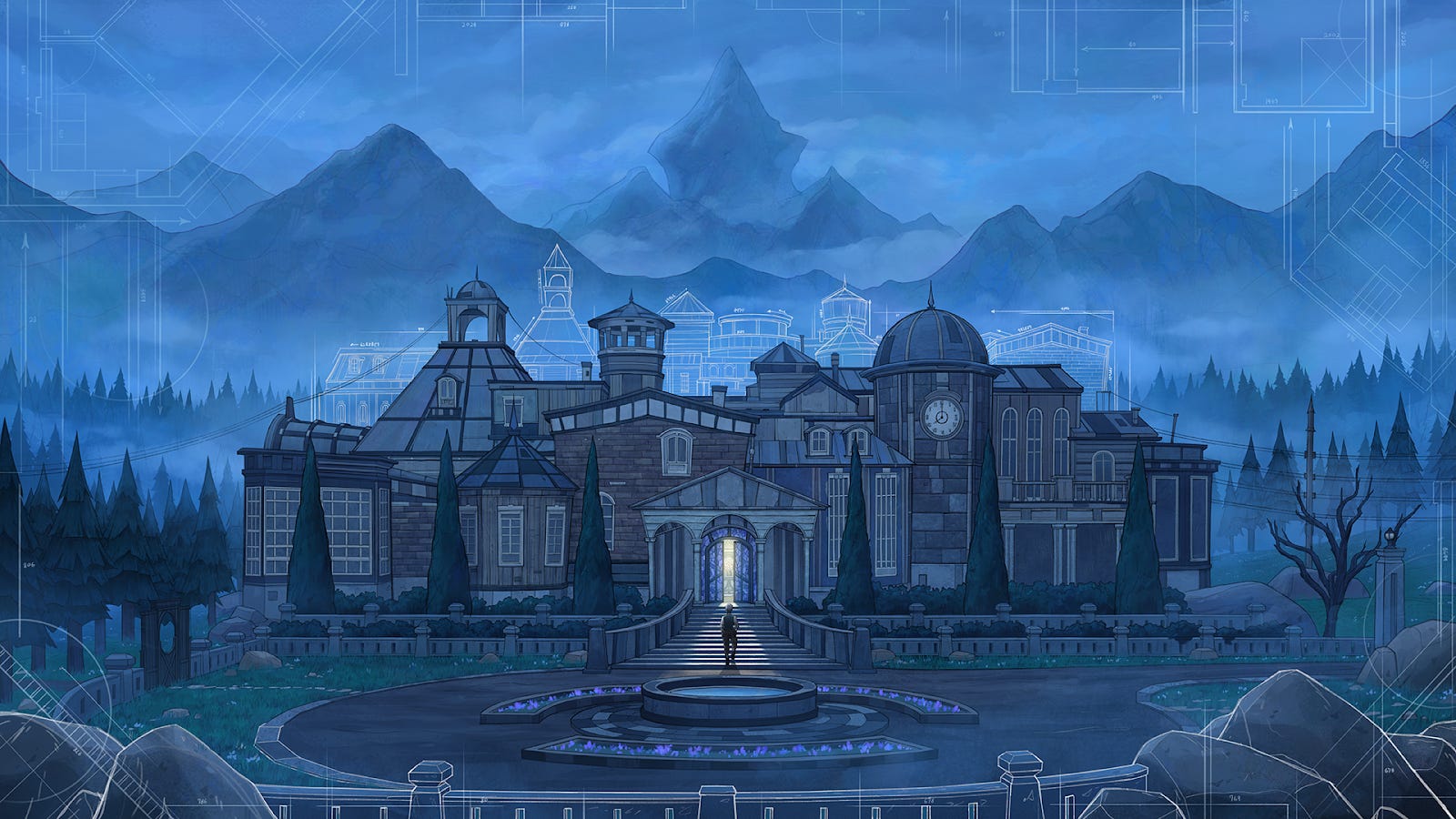
The first meaning is literal, as it refers to the main character you play, Simon P. Jones: the young heir of the infamous mountain estate, Mt. Holly. The second meaning has to do with the core mechanic of the game: the drafting system, or selecting ‘blueprints’.
Clever little name, if you ask me!
As you slowly unravel the core mystery hidden at the end of the game, your identity, the role you play in the narrative, as well as the ever-changing landscape of the house, continue to become clearer and clearer.
The game’s story starts here: you are the soon-to-be inheritor of the Mt. Holly estate, from your late great-uncle H.S. Sinclair, a camera company magnate who had resided on the property for many years, until recently.
You find yourself in the main hall as you start the game, and lying on a round table at the center of the first room, is a note penned by Sinclair in his hand. In this note, you find that Sinclair has bequeathed the entire property, its land and all the possessions in it to you, with one stipulation: make it to Room 46.
Once you have done so, all that has been promised will be earned, and the estate will be yours.
It’s an engaging impetus for a fantastic story. It’s filled with enough intrigue in its backstory, I think there could be a story to tell in some sort of sequel or book all to itself.
It’s a fascinating world, setting, and cast of characters you encounter as you skim the many notes, letters, directions, and orders that pepper the many desks, chairs, and pieces of furniture that furnish the house’s rooms.
There are dark dealings, dangerous conspiracies, racial tensions, political firestorms, kidnappings, and heists galore in the story of Blue Prince, and from what I was able to glean, I found that by the end, the tale was well-told and satisfying as I reached its conclusion.
Once the literal ‘table-setting’ has been done, you begin a run.
Each morning, you start a run with a budget of ‘steps’ located in the top left corner of the display. Think of this as a sort of currency of ‘movement’, if you will. Every time you cross the threshold in a drafted room, a step ticks down from the counter.
Once you run out of steps, your run effectively and automatically ends, with you becoming exhausted and fading out into a stats screen showing your day’s progress in exploring the manor.
At first, it can be stressful, especially in the early game while you get your bearings, because you’re always wanting to keep an eye on that counter.
Gamefying traversal is a very novel mechanic, in my opinion. I have never, ever seen a puzzle game, let alone any game, have this mechanic, and I think it’s one of the freshest things about Blue Prince on a purely game design level.
It’s very smart. Limiting the player with movement makes them make harder and harder choices on how they want to spend their day. Sometimes, even drafted rooms you choose beyond each door will add or subtract steps depending on that chosen room’s ‘quirk’, as it were.
For instance, purple colored bedrooms can add steps to your counter, and red rooms like: the weight room, can effectively cut your banked steps in half.
There are ways to regain steps, though. Through careful selection of rooms, purchasing consumables in the form of ‘fruit’ (each with their own steps awarded for eating them), and drafting different rooms giving specific gifts for doing so, there are ways to keep a run going if you know how to maximize your step-counter.
It’s that push and pull of the step-counter that makes playing Blue Prince specifically so interesting, I think.
In totality, between each ‘day’ or ‘run’, you end up searching the house’s rooms for hours, combing over the minute details with a fine-toothed comb, thinking maybe some piece of information that you come across will be relevant once you understand more of the game.
You read myriad notes from the people who lived and worked at the estate over the many years, reading and gleaning tiny bits of precious information you can use as you continue to explore.
Every note is vital and purposeful.
You never quite know when a piece of information you learned 5 hours ago will come into play as you find ways to draft deeper and longer into the house’s floor plan.
In early drafting rooms, little tutorial notes from the owner of Mt. Holly appear, giving you little tips and tricks as you start your run. The most important one is this: take notes.
Initially, I scoffed at that. “I don’t need to keep track of shit!”, I said to myself upon reading it. “I don’t need a journal for this stuff. I can keep it all straight.”
Well, that was hubris.
Keeping track of all the information you find by yourself is tough. I highly recommend keeping at least a NotesApp jot log up on your phone as you play, just in case.
When I finally gave in, it became a godsend to me. Shelving valuable info for later became crucial to my remembering things as I got deeper into my runs.
Don’t be like how I was at first. Just swallow the pride and write little reminders. I promise it will help.
As the layout changes, the rooms in their stasis do not. What does change, however, is what items are placed in each room. Besides your currency of steps, you can collect items in the game that you will need to progress in a run.
Keys, gems, sledgehammers, metal detectors, keycards, and random elements hide in each room you select in the drafting phase, with most rooms showing how many of a given item are in each room you can pick to select.
Gems and keys are by far the most useful of these items. Without a hefty amount of each, you won’t go far in the manor.
As you rise up the map (the floor plan) amongst the 45 empty tiles, you will reach doors that require keys or gems to progress. If you run out of these in a run, either by spending them or not being able to draft rooms that include them, you will effectively lock yourself out of being able to draft rooms.
Having a balanced drafting strategy between progress, quirks, and items is essential to reaching the end of a run. What I would say to an early player of Blue Prince is this: just don’t sweat picking the right rooms.
At least, initially.
Until you have enough knowledge to traverse the house and its rooms, understanding what is a good and bad room doesn’t matter in the early game. The only way you learn in the game is to pick a room and see what’s there. It’s all random what you get, after all.
If you are unsure of which room to draft, I would always say draft a room you have never seen. Doing so, it will equip you with new ways to go throughout the house and will allow that new room to be drafted more often in your ‘deck’ as it were.
Before each door, you are given a random assortment of rooms to pick from to populate the threshold beyond, and this mechanic is the main thrust of how your days go in terms of where you go and what you do in a given run.
Drafting rooms well is essential to you being able to do what you need to in a given day. Strategy is paramount, but until you know what you are looking for and what you want in a room on the floor plan, it’s tough to plan out the early stages of your playthrough.
It lends to many ‘eureka’ moments throughout, to be sure, but also its very random nature leads to just as many frustrations by the end as well. It’s not a perfect masterpiece. It’s a very messy one, I will say, even given its many strokes of genius.
I do think the game design works more often than it doesn’t, though.
I think you can’t have the good without the bad, unfortunately. Because without it, Blue Prince just isn’t as novel a game, I think.
That core mechanic of randomness makes for a thrilling adventure, while at the same time being its biggest weakness, on the whole.
I do think that this is where my main gripe lies with the game’s design, however.
Once you establish a sort of base knowledge of what you need to do, where to go, and what to draft (either based on direction, synergy with adjoining rooms, or even the items in a selected room), because it’s inherently a ‘rogue-lite’ game, the design of the game can fight against a well-equipped player, as the game progresses.
There were many times, especially in the ‘Final Run’ of the game, when I needed specific things to happen. Whether it be an item to show up, a floor plan to populate, or a mechanic to be present, whatever it was… Accomplishing the goal of reaching Room 46 became very tedious because of the inherent RNG mechanics that were the foundation for the core systems of the game.
Once I knew what to do and where to go, all I could hope for was literally for ‘luck to be my landlord’. I had to hope against hope I would get the right rooms with the right items to show up to complete the Final Run.
There was a point around the 14th hour of my playthrough of Blue Prince where I had to step away from it out of frustration, simply because I reached a roadblock when I thought it was the final destination.
In reality, I wasn’t as close, but I did unlock a vital piece of knowledge to use when I finally did complete my run.
I use this example to show that having a run end is heartbreaking in Blue Prince when you have all you need at your disposal, yet the RNG fucks you over.
Getting the perfect run is so hard to do given all the variability of the game’s design and mechanics.
The random nature of Blue Prince has two sides of the same coin, good and bad. It’s both the greatest thing about it and the most frustrating thing I encountered while playing it.
I think it’s the sort of brilliance only a few games can capture. It’s a rare thing to see it in games these days, but when those select few come around, it is truly special.
I loved Blue Prince. I hated Blue Prince. It took me around 16 hours to finish the Final Run, and I was thrilled to reach the end. Of course, since it’s run-based, you can play endlessly— doing challenge runs, unlocking trophies or achievements, whatever you want. I felt at peace finishing it once and being done with it. I did enjoy myself most of the way through, I will say.
Most of my time spent with the game was very positive, but I will freely admit that the major issue I had with it ultimately colored my perception of it by the time I finished.
At its best, Blue Prince is a dizzying triumph in the puzzle genre: one that stands alongside a select few games for me. It’s a gorgeously rendered, beautifully crafted world and setting, with a heartwarming story and brilliant writing to guide the proceedings.
If you can stomach the large hurdles the game asks you to vault over between its bookends, you will hopefully come out the other side with the same verdict I came to.
Which is this: Blue Prince is a can’t-miss game for fans of the genre, a towering achievement of narrative excellence and mechanical complexity that is a rare and resounding triumph of the medium.
At times, it is a frustrating journey, but the journey travelled is well worth it, with the end being a satisfying conclusion to a wonderful tale. If you can arm yourself with the knowledge to conquer its manic happenstance, you will find that beyond each door of Blue Prince, there is a world to discover behind it.
I highly recommend this game.
Even if you don’t like these sorts of games, I encourage you to play it. I think you will be glad you did.
Keep gaming, folks– and I appreciate your time.