

Digital Pangaea
A review of Death Stranding as a series, Kojima's weirdness, and artistic stamps on creative endeavors.

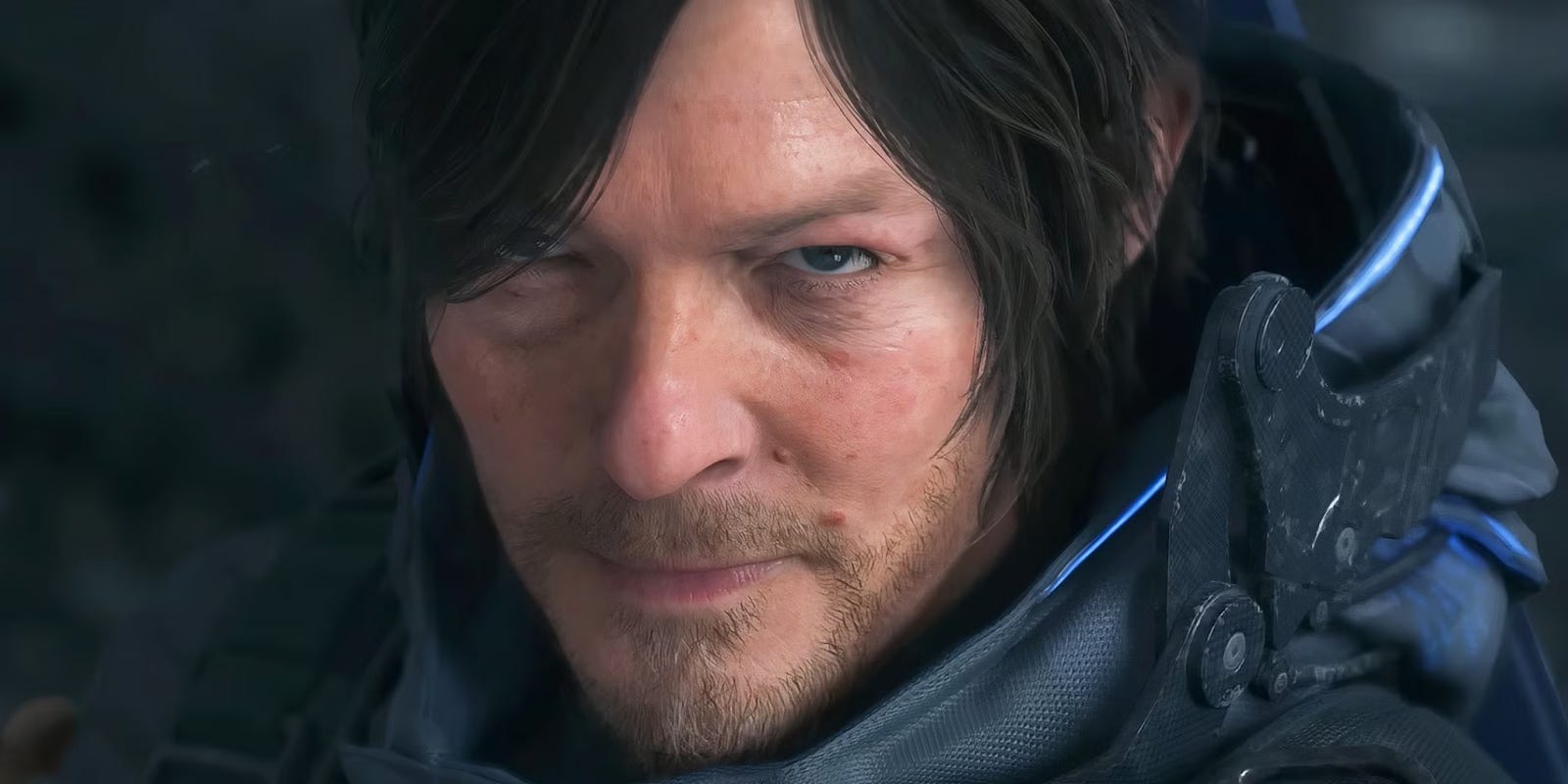
I’ve never seen “‘Ride’ with Norman Reedus”, on AMC, and I don’t think I will seek it out… But the product placement in Death Stranding (1) was hilarious. Bring back my Monster Energy, you bastards.
I need my stamina!
Okay…
So, the thing I said about Clair Obscur a month or so ago?
About it being my game of the year?... Yeahhh about that… Between playing this and barrel-blasting through Donkey Kong Bananza, that may no longer be the case.
I think Death Stranding 2 is perhaps the single most original and prescient work of art I have experienced in video games in the last quarter-century. It is truly a spectacular game.
Lofty claims aside… I think it is perhaps the most audacious and quirky AAA game I have ever played, too.
Kojima does what other developers would not: he inserts himself into every aspect of his creation, adding a distinct, crafted feel to the entire product. Everything in DS2 is a bespoke and unique piece of Kojima’s soul, injecting each tidbit and interesting mechanic found in the game with more thought, care, and heart than most titles you can see in this space. It may just be my favorite game I have played this year, and the past few years. It’s tough, though, given that we are only halfway through the year. Seems a bit early to crown it the ‘champ’ when I haven’t fully gotten through the year of our lord 2025, right? As seen with my Clair Obscur review, that confidence has proven to be my downfall. Maybe it’s just a banger year for games??
To start, I have very few criticisms to levy at DS2, so prepare for (maybe) the most biased review I have done yet on this Substack. I love this game. I truly think it’s one of the greatest games I have ever had the pleasure of playing.
Do you ever get that sense when you are playing a truly special game, that it is one of those ‘landmark’ experiences? Like, you think outside of yourself for a moment, and scrutinize the way you feel about something you are loving so wholly and completely– arriving at that rare verdict that you have been playing one of the very best games you’ve ever played?
Yeah, that was this game for me, in a nutshell.
Kojima is in his bag here in such a way that no one would dare imitate. I believe there are a few true ‘auteurs’ left making video games these days. True visionaries and industry luminaries who push the envelope and boundaries of what people think is possible in a digital landscape.
I think Sam Lake (the creative director and writer of some of Remedy’s biggest titles, like Control and the Alan Wake series) belongs in this select few; as do industry giants like Hidetaka Miyazaki from From Software, Todd Howard from Bethesda Game Studios, and Fumito Ueda from genDesign (known most famously as being the lead creative at legendary studio Team ICO, the iconic studio behind legendary PS2 titles ICO and Shadow of the Colossus, respectively).
Hideo Kojima is perhaps the most prestigious and decorated of this group, I think. Kojima stands a full head and shoulders over these talented individuals for his myriad accomplishments in the video game industry, and he is the trendsetter for an industry that is always evolving, it seems.
When these guys make video games, the whole industry pays attention. Like directors Denis Villeneuve or Christopher Nolan making a huge blockbuster movie for theaters, so too do these developers demand attention and respect for their work. More than all others, though, all eyes are on Kojima every time he is working with his team to create a new game.
Why is this the case? Well… Kojima is just a fucking weird dude.
This is a compliment, by the way.
He is invested in his games. So much so that when he is making one, he lets you know he was a part of many aspects of its inception and creation. Usually, the credit text in both trailers, on box art, and in the final product has his name thrown around all over it for the viewer/gamer to see.
Produced, designed, written, and directed by Hideo Kojima is kinda what you’ll see these days. The man wears many hats, it seems. It is disingenuous to think that he is truly doing all of the hard work himself, but like a David Lynch or even a Spike Lee, he makes sure to tell the audience that any game with his involvement in a creative capacity is his ‘thing’. Spike Lee will throw up ‘A Spike Lee Joint’ on his stuff, and David Lynch (RIP, you beauty of a man) movies will bear his name in turn, as well. These auteurs want you to know that not only did they have a hand in making these creative endeavors, but they are their proverbial ‘babies’, for lack of a better term. They, as creatives, are a part of every fiber of their project’s makeup from inception to delivery, and when these people show off their production fully formed, each aspect bears, in some way, their ‘mark’.
Kojima is known for slinging around his name, right? If you know anything about him making games, the man has an ego. He’s slapping that bitch everywhere. This was most prevalent in the Metal Gear Solid series (and especially in MGSV), where practically you couldn’t transition cutscenes damn near without seeing that Kojima made the fucking thing you’re playing. It could come off as pretentious and annoying (it sure has bothered me in the past), but I find it more comical than anything these days. It’s just very funny to see it’s ‘A Hideo Kojima Game’, 73 times, while being airlifted to a warzone in Metal Gear Solid V to ‘fulton’ sheep for your base’s animal petting zoo.
Kojima cracks me up, man.
So, back to the task at hand. Death Stranding 2.
In truth, it is a lot like the first one, albeit tighter, more fun, and less arduous. When DS1 hit the scene in 2019, it was somewhat of an anomaly. More than any other game I can think of in its promotional cycle, Death Stranding baffled and bemused many an industry pundit as it made its way to store shelves. At its heart, it was just a uniquely weird project to understand. What was with all the babies and tar monsters? Why was Norman Reedus so….Nude?
The lead-up to launch was entertaining to say the least. Every little bit until it came out, I remember the slow trickle of trailers hitting the timeline, with more and more people being increasingly bewildered by the odd visuals and morose music accompanying each. The discourse back then was a bit more… Tame? Civil? Seems like we have lost some decency since that time. This was before COVID, mind you, in 2019— a few months before the most devastating and socially disruptive human event in decades had taken place. Seeing the way people felt and talked about the game itself during that period and upon release was fascinating. The themes of the game itself were so prescient and forward-thinking that the fact that DS1 came out before a global pandemic is nothing short of stupefying.
The themes of connection (or the lack thereof) amidst an apocalyptic world event, and eventual mending of socioeconomic dynamics between people in places of refuge was felt so clearly in the real world during this time. Its truly amazing how timely the game all was, in hindsight, as it came to its setting, story, and themes. It was so eerily similar (if it weren’t in such poor taste), you could see the world and the state America found itself in as a weirdly topical marketing tool for a game that seemed, in some ways, to have predicted a small part of the future. Or at least, the people who made it had been thinking about those themes for some time, and it was by some cruel coincidence that some aspects of their design had been made manifest by a world in turmoil. Life usually impacts art, but rarely do you see art be so prescient and damn near ‘predictive’ of a world caught in the throes of a real event in history, almost simultaneously.
The fact that Kojima Productions did this very same ‘predictive theming’, again in Death Stranding 2, is so shocking, it’s hard to call it a fluke.
Is Kojima a sage? A wise man??
Could Kojima be Nostradamus?
Kojima has done this before, as well! Metal Gear Solid 2: Sons of Liberty predicted the entire 21st Century as it comes to governmental oversight, and digital information in the modern age. The idea of informational dissemination, and internet ‘enshittification’, is not a new thought. Flooding an entire connected network full of people living a digital life with junk news, alternative information, and downright governmental deception is literally the entire plot of the back half of that game. Solidus Snake lays it out for you in the fight with Raiden. It’s so clear Kojima thought about the digital age as a new frontier for malfeasance and governmental conspiracy, specifically as it came to the U.S.’s involvement in the virtual global landscape.
So the idea that Kojima hasn’t done this thing before, and has been mostly correct about core tenets of certain themes of his games, is just wrong. He has, and Death Stranding 2 is the 3rd time I can think of where his art is holding a mirror up to life and vice versa.
Once you are lucky, twice you are wise, but three times…? You may have foresight.
I loved Death Stranding. The first one, that is. It was a prickly game that pushed back at you as you played it. Sure, there were tar monsters and evil mailmen that wanted to kill you and steal your precious packages so they could get a chemical ‘high’ from the pilfering. The main antagonist in that first game, however, was the terrain. Mother Nature is an indifferent host, of course. It has no motives other than to grow and decay whilst lifeforms coexist in symbiosis with it, living and dying alongside its systems. You feel like an ant in this world, made to work and make your meager, little life better, in a world nonplussed by your existence.
In short, you are a porter. Sam Bridges, to be exact. Played with all the dull charm and cardboard fluidity of a movie standee by popular television actor Norman Reedus. He is a cipher for you to view this world and move about inside it, and that’s about it. He gets more to do and say in the second entry, but even still, he clearly feels like a player stand-in to ask the weird story-related questions on behalf of us as gamers. Norman Reedus also has a kid named Mingus. Did you know that?
His involvement is interesting as it comes to this project. He was tied to another video game with Hideo Kojima attached (even before Death Stranding), called ‘Silent Hills’. A horror revival of a popular Konami series that had been in a state of flux for years prior. Konami put out what became maybe the most iconic demo for a game ever, in ‘P.T.’, or ‘playable teaser’, as a way to promote that the game was in development with Kojima directing and producing, cinematic luminary Guillermo Del Toro involved creatively, and Reedus starring in the game. When Konami and Kojima split creatively following the release of ‘Metal Gear Solid V: The Phantom Pain’, ‘Silent Hills’ was cancelled, and the three attached went their separate ways… Or so we thought.
Norman Reedus and, soon, even del Toro showed up in the trailers of Death Stranding, following the split. Seems like their creative spark still had light. It’s unclear what del Toro’s involvement is in the Death Stranding series aside from his digital likeness being used for a non-playable, story-critical character, but the fact that he was included at all made the spirit of that cancelled Silent Hill game live on in the new project, even in a small way. One thing about Kojima? He is gonna scan some folks. You can’t party with the big boys unless you show the bottoms of your feet, right? (Justice for Stephanie Joosten, by the way.)
In the most concise of explanations, Death Stranding is a package delivery game. Except you are a heavily-armored UPS man that uses blood grenades to combat tar ghosts, with a mounted baby in a jar that can detect said spirits on your person. This is just a normal video game, I promise. They’re all like this!
You spend your time working for what remains of the government in DS1, linking up places of refuge (people in bunkers, shelters, or distribution warehouses) onto what is known as ‘the chiral network’, or the ghost internet. Normal video game things, you know? You deliver packages, people, pizza… whatever folks want to get sent to them. It’s very fun! I like this aspect of the series. The rhythms of prepping for a long journey and fixing infrastructure on the way are supremely satisfying to me.
A cycle of a normal delivery goes like this. You reach a terminal with a person or thing asking you to do something for them, you examine the cargo and weight of the freight for the delivery, plot your course, select your kit and equipment (selecting any vehicles along the way), and off you go. You reach your destination, with (hopefully) your cargo intact or in good shape, you get graded for said condition, and you increase your relationship level with the recipient. Rinse, repeat.
It’s such a satisfying loop. I think I could play both games all day and not get tired. It’s so specifically my ‘type of bullshit’, I could easily sink many, many hours into the games and not get bored. I have done this very thing.
Combined between the two titles, I have well over 150 hours of gameplay time. It’s gross, I know. What can I say… I like delivering pizzas to Troy Baker, okay?
The best thing about both games is this rhythm. The movement back and forth and the interplay of the systems between. It’s such a mechanically satisfying and audio-visual feast for the discerning porter, and I can’t get enough of the simulation in both titles. The unique thing about Death Stranding (besides, well, all of it) is the social dynamism at play with other players also playing the game alongside you, albeit siloed in their bespoke worlds with their versions of ‘Sam’ making the same deliveries.
When you drop a ladder or a bridge in either game, those items can appear in other players’ games to aid them on their journey. It includes social cooperation and integration while removing toxicity and hatred from its design, leaving the positive aspects of a social circle, while getting rid of what makes its inclusion bad for your health, so to speak.
You won’t have a single bad or ‘troll-y’ experience with the ‘strand-type’ mechanics of this game because they are passively integrated seamlessly into the experience. The only time you can interface with ‘people’ is by ‘liking’ their projects or items with a button, telling that person how much you appreciate the hard work they did to make your journey that much easier. I love the ‘jolly’ cooperation of this multiplayer, and its inclusion is maybe the most ingenious implementation of social mechanics I have seen in a game yet. It’s all a positive experience, too. How many games with social additions can you say that about?
The good and the bad go hand and hand, though. In both games, the BT (‘beached things’) or ‘tar-monster’ sections are arduous and grueling affairs. DS2 doesn’t improve on it either, but it makes the encounters less frequent, which is a welcome change. When these show up, they are a slog. Always.
Sometimes you will get your odredek (ghost GPS) warning you about a BT zone, and sometimes it will just happen to you. Story-related mostly, but otherwise it sometimes just shows up to fuck your day up. Being unprepared for this eventuality will make you have a baaad time. Equipping yourself properly is the key to your continued survival. That stuff sucks, but it’s a minor con to a game full of pros, for me. Again, DS2 improves on the original in so many distinct ways, from gameplay to graphical fidelity to the soundscape, it’s easier to enjoy the sequel with them removing the cruft from the original that burdened the player initially.
I guess this whole thing is a review of Death Stranding as a whole, with both games. I came here to review the second game, but you kinda have to talk about the first one to do so, right?
DS2, like I said, is a major improvement over the first. Especially in the story.
I like the themes and characters of that first game a lot, but here, Kojima has assembled a murderer’s row of talented voice actors, iconic character models (scanned after mostly real people), crafted a resonant and emotionally somber soundtrack (mostly curated and created by French music director and composer Woodkid) with a fantastic ending to the proceedings that really hits home just what this whole world is coming to, yet again.
To spoil the very ending of this game (or the last 3-4 hours of it) would be to ruin a great surprise. Kojima, as I have alluded to, is doing ‘it’ again. Nostradamus or not, he has figured out a new way to shock, inspire, and bewilder with the germ of this story, that is, again, so prescient as to predict the state of the world we currently find ourselves in.
I am not sure how he does it…
I wanna dive even deeper… But this review is long enough. I guess this is me talking about the whole series and its overarching themes and creation more than the game, here. But that’s fine. I haven’t even talked about ‘Dollman’. Fuck. It’s fine, though. DS2 needs to be seen to be believed anyway.
It’s a monumental, towering achievement in almost every category for me, and I will be thinking about its accomplishments, I imagine, for many years to come. Until the next Kojima Productions game, I expect. I highly recommend this game and all of its facets. It's more fun, more unique, more weird, and more Kojima than even the first Death Stranding, and I think it’s fantastic.
Alexa? Play ‘To the Wilder’, by Woodkid, again, please? I’m ready to feel something again.
Keep gaming!