
Printing Prestige
A review of Capcom's new IP, "Pragmata". A game that successfully juggles a new puzzle concept with crisp, tight, third-person gunplay, and great characters, to bring about a dazzling first effort.

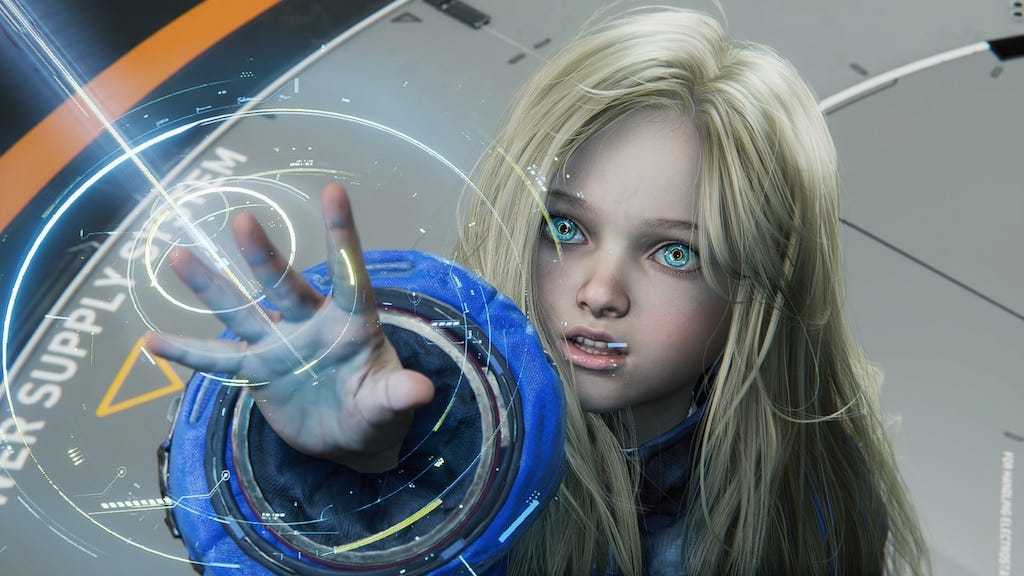
Diana steals the show here. She has a manic, gremlin-like energy that is perfect for her role and her diminutive stature in “Pragmata”.
Pragmata is a hit, both critically and commercially, for Capcom, and for good reason. It’s a great game that does just about everything right. It’s a wonder that Capcom has nailed it so well this first go ‘round, I can’t think of too many issues that hampered my enjoyment while playing through it. I think it’s a credit to the company that made it that Pragmata is as good as it is, despite the 6 to 8-year development time. It was revealed at “The Future of Gaming” Sony State of Play show all the way back in 2020. It debuted alongside the likes of Spider-Man: Miles Morales, Ratchet and Clank: Rift Apart, Bugsnax, and Horizon: Forbidden West in that show, so to say it’s been a long time coming is a bit of an understatement. For some companies, long development times can mean projects that are in deep crisis, mothballed, or worse. But for the select few, these long, slow developments can yield fantastic results, and we see proof positive of that latter outcome with the success of Pragmata.
It makes sense that it took as long as it did, but if you look around and see what they have made, forgetting its runtime? It feels like a brand-new idea. A genre unto itself at points, even. I enjoyed seeing the familiar notes of stock-standard third-person shooting altered in fun ways with this added degree of complexity to the gameplay. The maze-running grid minigame Diana does to hack bots, along with Hugh’s standard shooting gameplay, gives a familiar format some much-needed life. It feels like just enough complexity has been installed to keep the plate-spinning in the combat that much more engaging. Once you get the hang of it, it kind of becomes some odd ‘zen-action’ gameplay. You sorta go into a hyper-focused trance attempting to ‘juggle the balls up in the air’, as it were, and that feeling doesn’t wear out its welcome throughout once you can harness your combat abilities.
While some mechanics get on the side of outstaying their welcome, like the large arena battles where you fight scads of metallic white baddies in round-based entanglements, the act of simply playing as Hugh and Diana never gets old. Capcom has done well to make the mere act of moving through “The Cradle” (the Moon base that you are exploring in Pragmata) a thoroughly enjoyable experience that switches it up just enough to keep you engaged for the full duration of its 8-12-hour campaign.
It’s great fun to jet around as Hugh especially— because with the added mobility of a snappy double-jump as well as a crisp and clean multi-directional dash move, you feel as though you can surmount any physical obstacle or geometric impediment that the game throws at you. I dare say it’s some of the best-feeling locomotion and perhaps one of the best movesets for a playable character I have encountered in an action game in quite a bit. Everything you want to do, you can do, and the game honors your inputs every time. I appreciate it when I can trust a game to allow me to pull off the movement I am attempting with very minor push-back.
The moveset rocks, the combat is extremely solid, and the interplay between Hugh and Diana (the robotic Pragamata in… Pragmata) is very entertaining. Their conversations and interactions are the heart of the game, after all, and I believe it’d be a lesser experience without the two. The mechanics are one thing, but if you don’t have the characterization to motivate the gameplay, it would be a far worse game for it.
Good thing, then, that Diana is one of the best sidekicks Capcom has made yet. Every little character moment with her, like the bits of funny dialogue she has when commenting on the state of the world (or how she sees it), fun interactions with Diana at home base, in-depth conversations with Hugh throughout their journey, and just the overall sweetness she brings to the table with her adorable gremlin-like presence, is great. She is a well-rounded, extremely entertaining, childlike being. She has a genuine pathos that we don’t see very often in triple-A games when it comes to children, too. More games should do more work to show children as inquisitive, sensitive creatures, rather than annoying, belligerent nuisances, like we usually see. Diana is the exception, not the rule, and I wish more games would take notes from her character going forward. By the end, I found myself wanting to see even more of her in a sequel, and that’s a great feeling to have about a brand-new character. Diana is great, and she is perhaps the best part of Pragmata, all told.
Of the two main protagonists, Hugh is the one I like the least, which makes sense, given just how strong Diana is as a character, but I couldn’t help but feel like I wanted more from him. He feels like a spin on the generic ‘white savior’ or ‘gunman on the box’ archetype to me, and maybe that’s a bit unfair given that Hugh has more going on than the faceless military protags of the past 20 years in games, but the feeling remains. At the end of the day, Hugh is kind of a naive, lovable dope, and that’s very much okay, given Diana’s dynamism. He is a good vessel to convey a regular ‘degular’ average Joe’s experience working for an Earth mega-corporation, and his inclusion in the story is really to be the cipher for the player and be the audience stand-in to field Diana’s numerous inquiries. He gets the job done, but let’s just say his lights are on, but sometimes… no one is home. Sometimes. He is fine, really! I don’t hate the guy!
The two’s relationship blossoms into more of a brother and young sister relationship rather than a generic sad dad and misguided offspring tale, and the eschewing of the regular ‘lone wolf and cub’ trope for more of this refreshing twist of familial regard is something I welcomed greatly. They get along and bicker like siblings, after all, and instead of the authoritative tenor of parental guidance these older protagonists usually have when addressing their younger counterparts, Hugh and Diana have a mutual respect and understanding of each other as equals in the tale.
I like that spin on things, and their dynamic is extremely successful in making the game work on multiple levels. If their relationship isn’t nearly as good, I truly believe this game falls apart. There was clearly a lot of care put into how gamers would perceive the two of them throughout, and many specific choices were obviously made to endear the two to players of the game, I believe. Pragmata is successful because its two main characters genuinely like each other, and while maybe that isn’t the sole reason for the game’s victories— I do believe it’s a large reason why it has done so well for itself and Capcom.
The positives are aplenty in Pragmata. After you wrap up the game, you have the option to tackle any collectibles (REMS you can bring back to base for Diana), VR missions (tasks to earn powerful upgrades and weapons), and even new challenges that unlock the true ending of the game. While I have yet to do everything, I am confident that I eventually will. If there is one thing that Capcom does the best, it’s offering continued reasons to play its games, be it by incentivizing multiple playthroughs like in the recent Resident Evil remakes and newer entries, as well as tackling harder challenges like those found in the Devil May Cry series. Pragmata has a lot of added stuff to do after the credits roll, and I commend Capcom for keeping with their previous IPs’ traditions of added reasons to play after a playthrough.
The story itself may be the weakest part of the game, if I had a minor gripe, however. Besides the characters interacting, I didn’t really get that much out of the main thrust of the narrative or its particulars. Sure, it’s fine and workable, but the villain is terribly middling and not very interesting, and that may be the biggest issue I have with the game. It’s small potatoes all told, but I digress. For all the positives I have with Pragmata and its particulars, having one or two small issues doesn’t spoil the pot in the slightest. Great final boss fight, though. I felt particularly stretched for resources in the final encounter, and that’s a good thing. It felt like the culmination of the combat puzzle for me, and I like that quite a bit.
Pragmata is somewhat of a marvel in this modern video game landscape. A single-player third-person action shooter with puzzle mechanics in another era would scream ‘flop’ to me, but in the deft, reliable hands of the greatest third-party publisher working today, Capcom, they delivered an absolute triumph for a freshman effort. Bravo! Not every day a new IP works out, but given the time, care, and execution in its development, it’s not hard to see why it is a big win.
I highly recommend Pragmata. I would be shocked if it doesn’t make it on my year-end Game of the Year list by the time we wrap this calendar year, and I hope that if you read this, you will spend the money to find out for yourself. It’s well worth the purchase.
Thanks as always for reading, and as great sports scribe Dave Dameshek always says, “It’s been a thin slice of Heaven”.